 A disturbing confrontation between executive power and judicial authority appears to be unfolding in Imo State, following allegations that the State Government has continued activities on Housing Area “K” and Restoration Layout, New Owerri, despite a subsisting High Court judgment declaring the land in favour of the claimants and expressly restraining the government and those acting through it from entering, surveying, mapping or otherwise interfering with the property.
Court documents and information made available to bibncollar.com show that the dispute over the land dates back to 1999, when representatives of the Amawom people of Owerri Municipal Council instituted Suit No. HOW/146/1999 against the Imo State Government and other state authorities over the acquisition and control of the property.
The plaintiffs, acting for themselves and on behalf of the affected kindreds of Amawom Village, sought declarations affirming their entitlement to the statutory right of occupancy over the parcels known as Housing Area “K” and Restoration Layout. They also challenged purported government allocations, grants, leases and acquisition of portions of the land and sought orders restraining the government from further interference.
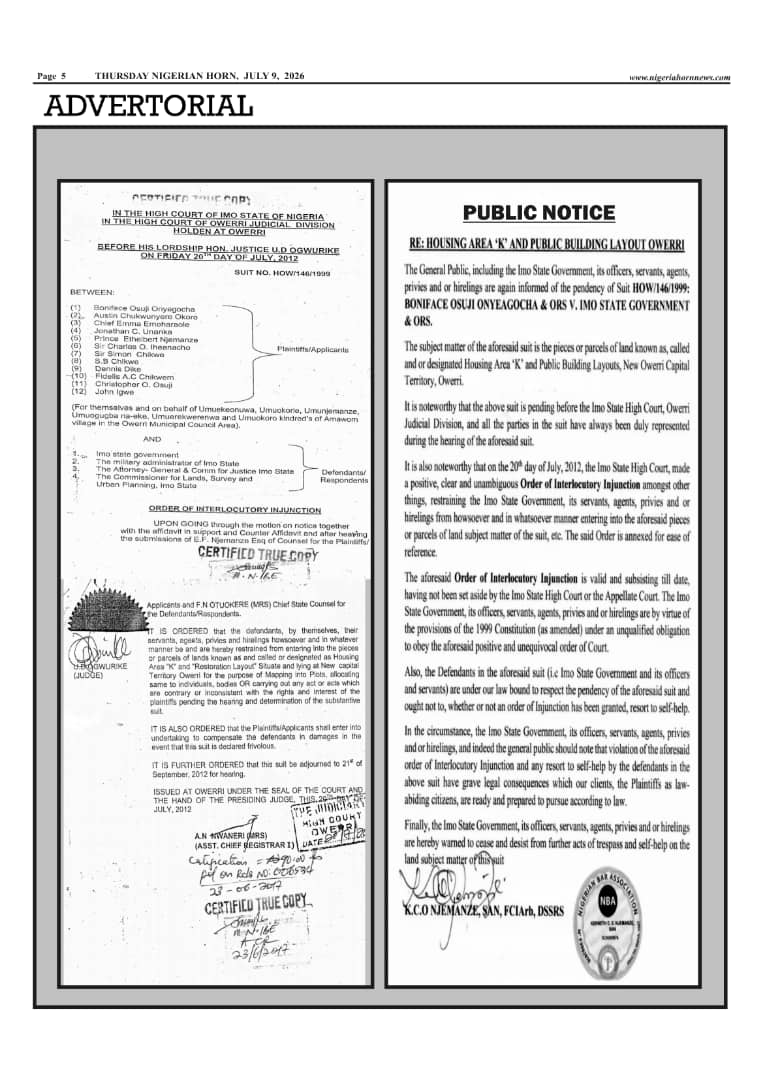
Long before the final determination of the case, the High Court had intervened. Documents made available to bibncollar.com show that an Order of Interlocutory Injunction was made in July 2012 restraining the Imo State Government, its servants, agents, privies and hirelings from entering or dealing with the disputed land pending the hearing and determination of the substantive suit. The order specifically restrained activities involving entry into the land, mapping it into plots, allocation of portions of it and other acts inconsistent with the interests claimed by the plaintiffs.
The existence of the injunction was subsequently brought to public attention through a notice published in the Nigerian Horn, warning the government, its officers, agents and members of the public against acts of trespass or self-help while the litigation remained pending.
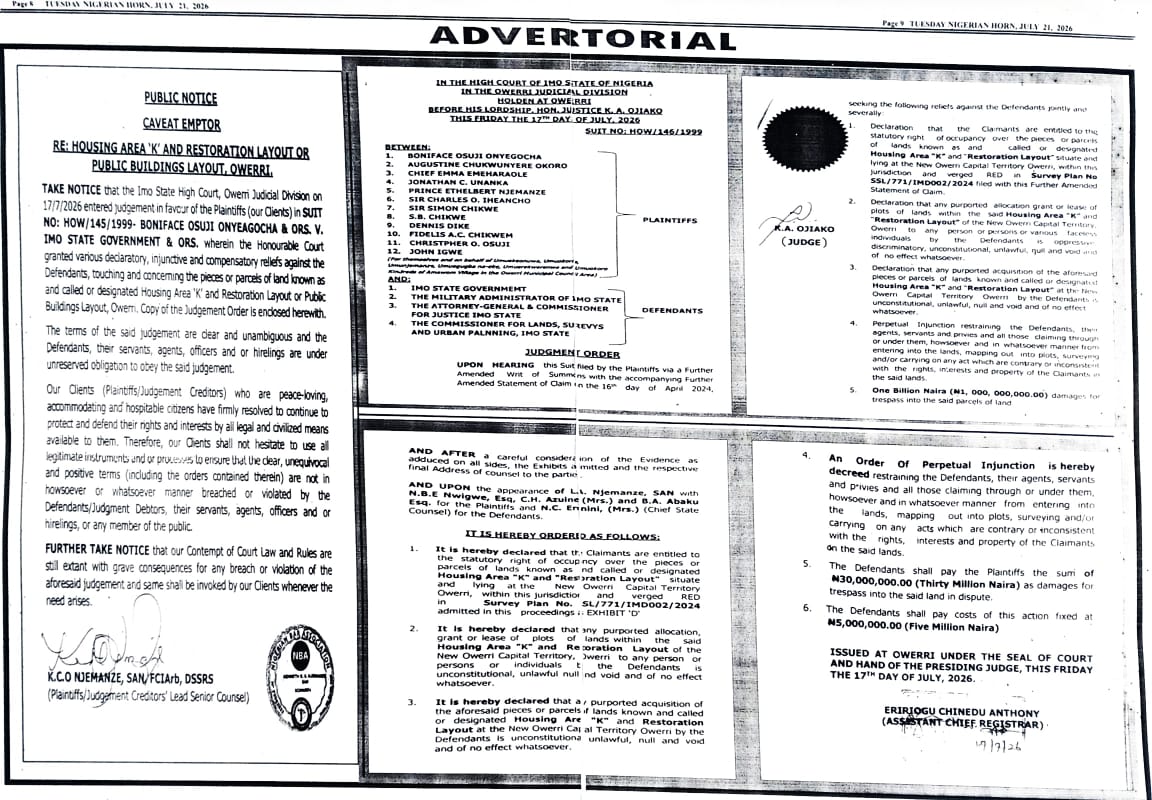
After more than two decades of litigation, judgment was eventually delivered on July 17, 2026, in favour of the claimants.
The judgment order seen by bibncollar.com declared that the claimants were entitled to the statutory right of occupancy over Housing Area “K” and Restoration Layout situated within the New Owerri Capital Territory and delineated in Survey Plan No. SSL/771/IMD002/2024.
More significantly, the court declared that “any purported allocation, grant or lease of plots of lands within the said Housing Area ‘K’ and Restoration Layout” by the defendants to any person or persons was unconstitutional, unlawful, null and void and of no effect whatsoever.
The court equally declared any purported acquisition of the affected land by the defendants unconstitutional, unlawful, null and void.
But the most consequential portion of the judgment for the present controversy is the order of perpetual injunction restraining the defendants, their agents, servants, privies and all persons claiming through or under them from entering the disputed land, mapping it into plots, surveying it or carrying out any act inconsistent with the rights and interests of the claimants.
In unmistakable terms, the order restrained them from “entering into the lands, mapping out into plots, surveying and/or carrying on any acts which are contrary or inconsistent with the rights, interests and property of the Claimants on the said lands.”
The court further ordered the defendants to pay the plaintiffs ₦30 million as damages for trespass and ₦5 million as costs of the action.
Yet sources made available to bibncollar.com allege that, notwithstanding the judgment, activities have continued on the affected property, including fencing and preparations for parcelling and development. If confirmed to be government-directed or undertaken by persons acting under government authority, such activities would appear directly at odds with the express terms of the perpetual injunction.
This is where the matter becomes particularly troubling. A government may disagree with a judgment. It may appeal it, challenge it or approach a higher court for appropriate relief. What no government committed to constitutional democracy should do is behave as though a judgment does not exist. If the Imo State Government is indeed continuing to enter, fence, survey or parcel this land while the July 17 order remains in force, such conduct deserves condemnation in the strongest possible terms. It would portray an administration treating judicial pronouncements as inconveniences to be ignored whenever they conflict with executive interests.
The sanctity of the courts does not depend on whether a government likes the decision handed down. Respect for judicial authority is tested precisely when a judgment goes against those who wield political power. A government that expects ordinary citizens to obey court orders cannot place itself above the same obligation. If state power can simply continue on the ground after a court has expressly said “do not enter, do not survey and do not map the land into plots,” then citizens are entitled to ask what protection a judgment truly offers against the might of government.
The alleged conduct is even more concerning because this is not the first judicial restraint connected with the property. The government was confronted with an interlocutory injunction while the case was pending, and the litigation has now ended at the trial court with a perpetual injunction. The progression from temporary restraint to final judgment leaves little ambiguity in the documents made available to bibncollar.com about what the defendants were ordered not to do.
There are also allegations that members of the claimant communities have been threatened should they attempt to enter the affected land. Those allegations are serious and should be investigated independently. No land dispute, particularly one already subjected to judicial determination, should become an excuse for intimidation, violence or the use of state power against citizens seeking to assert rights recognised by a court.
The Imo State Government therefore owes the public clear answers. Has the July 17 judgment been appealed? Has any court granted a stay of execution? Has the perpetual injunction been varied or set aside? If activities are presently taking place on Housing Area “K” and Restoration Layout, who authorised them and under what legal authority? Have portions of the land been allocated, surveyed or prepared for allocation after the judgment?
These are questions that go to the heart of constitutional government.
The dispute over Housing Area “K” began as a battle over land. Twenty-seven years later, it now threatens to become something more profound, a test of whether judicial authority means anything when confronted by executive power.
For now, the court documents speak plainly. The claimants were declared entitled to the land. Purported government acquisition and allocation were declared unlawful, null and void. The government and those acting through it were restrained perpetually from entering, surveying or mapping the property into plots.
If the land is nevertheless being parcelled, Imo State deserves to know why. And until the government produces a lawful basis for any continuing activity on the property, the uncomfortable impression remains that in this dispute, Government House may be behaving as though the judgment of the court is merely a piece of paper.
 A story of courage, wonder, and the transformative power of self-belief; perfect for readers aged 10+ who love adventure. To place order: +234 806 130 3237 | +234 803 582 0870 OR Tap the link to grab a copy:https://www.zeekapublish.com/product/the-magical-life-of-anna