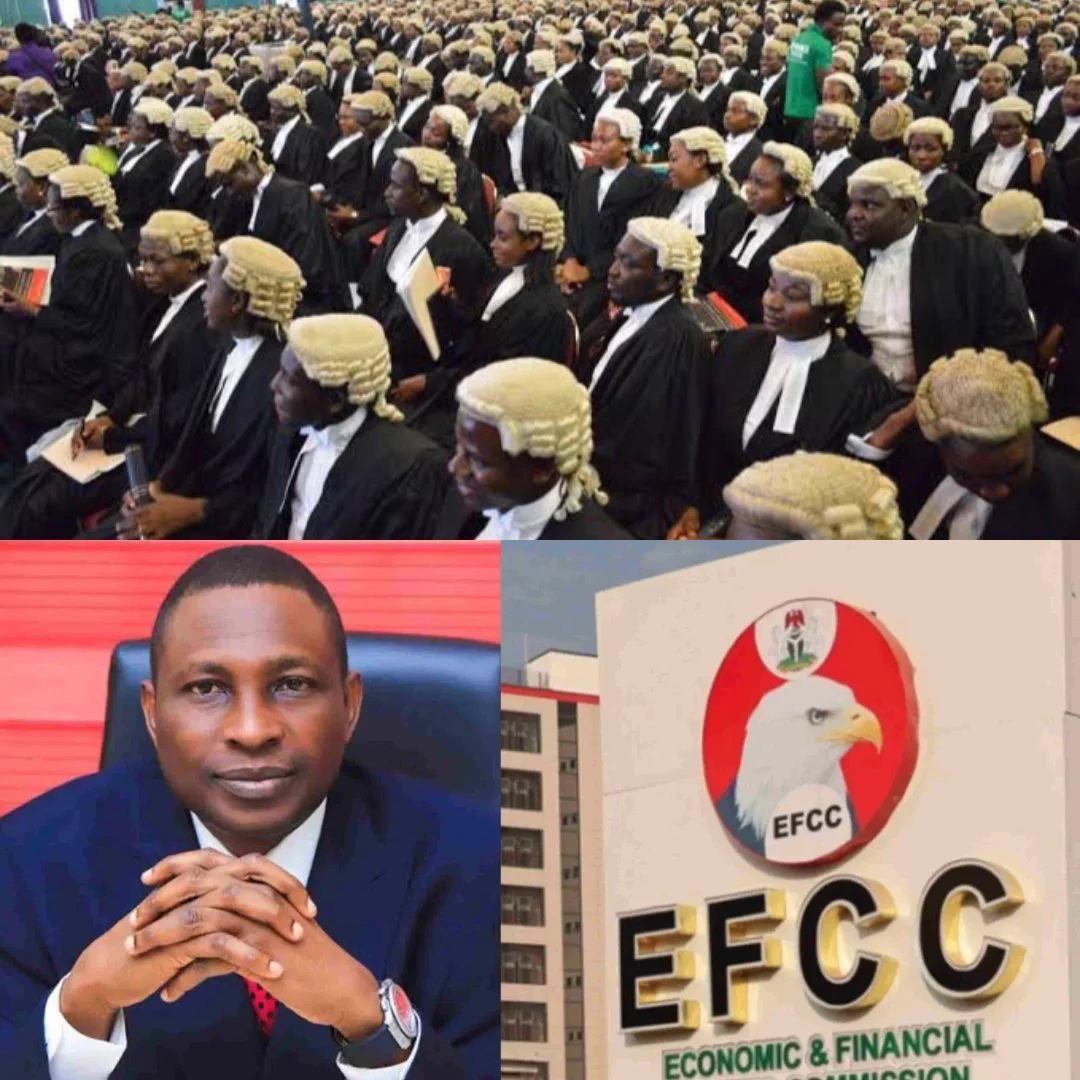
The Economic and Financial Crimes Commission has renewed its opposition to lawyers billing clients in foreign currencies, describing the practice as unethical and illegal and vowing to prosecute offenders, a stance that has drawn sharp criticism from Nigerian Bar Association branch leaders who say the agency lacks the power to regulate professional fees.
EFCC Acting Director of the Lagos Zonal Directorate 2, Ikoyi, Bawa Kaltungo, stated the commission’s position on September 11 during a courtesy visit by a Nigerian Bar Association task force on illegal practice of law. He said the agency is handling two cases involving lawyers who allegedly charged fees in dollars.
“We have two cases of lawyers who were found to have charged fees in dollars. This is unethical and illegal, as the naira is the country’s legal tender,” Kaltungo said. He added that any lawyer found culpable would be prosecuted and urged practitioners to stop invoking the EFCC’s name to justify excessive charges.
“Lawyers should stop name-dropping the EFCC to overcharge their clients. They have the right to charge their clients as much as they like, but they shouldn’t drag the EFCC into it,” he said.
The warning has been met with firm resistance from lawyers who argue that the regulation of legal fees falls outside the EFCC’s statutory remit. Nurudeen Abdulsalam, chairman of the NBA Gwagwalada branch in the Federal Capital Territory, said the Legal Practitioners Act vests that authority in the Legal Practitioners Remuneration Committee, not the anti-graft agency.
He pointed to the Legal Practitioners Remuneration (For Business, Legal Service and Representation) Order 2023, issued under the Act, as the framework governing lawyers’ charges. Abdulsalam noted the absence of any law that criminalises an agreement for fees to be paid in foreign currency and cited Section 36(12) of the 1999 Constitution, which requires offences and penalties to be defined in written law.
Dr. Uzoma Dioha, chairman of the NBA Anaocha branch in Anambra State, said the EFCC must distinguish its mandate to investigate economic and financial crimes from the regulation of professional remuneration. He referenced the Foreign Exchange (Monitoring and Miscellaneous Provisions) Act, which recognises professional fees as a legitimate source of foreign currency, and a 2007 Supreme Court-related case involving dollar-denominated claims.
Dioha argued that Section 20 of the Central Bank of Nigeria Act makes the naira legal tender and criminalises refusal to accept it, but does not automatically make every foreign-currency fee arrangement a crime. “No criminal offence can be created by a press statement,” he said.
Abuja-based lawyer Vivian Igbor described the EFCC’s position as having limited practical effect, particularly when dealing with foreign clients who may not hold naira. Senior lawyer Chief Chukwuma Nwachukwu said the agency had overstretched its role, noting that even government entities in the oil and gas sector routinely make payments partly in dollars.
The national leadership of the Nigerian Bar Association has not yet issued a formal response.
 A story of courage, wonder, and the transformative power of self-belief; perfect for readers aged 10+ who love adventure. To place order: +234 806 130 3237 | +234 803 582 0870 OR Tap the link to grab a copy:https://www.zeekapublish.com/product/the-magical-life-of-anna