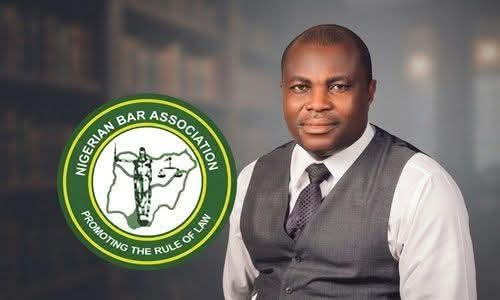
Alleges presiding judge is a postgraduate student in faculty where Udegbulem lectures; raises questions of possible bias, forum shopping and alleged irregularities in previous NBA Owerri election.
The legal battle surrounding the controversial ₦100 million donation by the Imo State Government to the Owerri Branch of the Nigerian Bar Association (NBA) took a dramatic turn on Wednesday, 28 October 2026, when Chidi B. Nworka, Chairman of the five-member committee constituted to investigate the management and disbursement of the fund, appeared before the High Court of Imo State with an application seeking the recusal of the presiding judge, Hon. Justice Mike Onyekachi.
The application, brought in Suit No. HAM/199/2026, instituted by Prof. Mazi Udegbulem against Chidi B. Nworka and the Registered Trustees of the Nigerian Bar Association, raises serious questions concerning the appearance of judicial impartiality, alleged forum shopping and the relationship between the claimant and the judge presiding over the proceedings.
In the six-page Motion on Notice, Nworka urges Justice Onyekachi to withdraw from further hearing the matter on grounds that circumstances surrounding the proceedings have given rise to an apprehension of possible undue influence and bias.
But beyond the recusal application, another controversy emerged concerning a bailiff’s proof of service which, according to an account of Wednesday’s proceedings, recorded that Nworka had been personally served through his secretary on 23 October 2026, a claim he vehemently disputed.
Recall that on Tuesday, 20 October 2026, Prof. Udegbulem had approached the court seeking an ex parte injunction restraining the Nworka-led investigative committee from carrying out its assignment.
Rather than grant the restraining order without hearing the other side, the court directed that the respondents be put on notice and adjourned the matter to Wednesday, 28 October 2026.
When the matter came up on the adjourned date, neither Prof. Udegbulem nor his counsel was reportedly present in court.
Nworka, however, appeared and brought to the attention of the court his application seeking the recusal of the presiding judge.
According to the account of the proceedings, the bailiff’s proof of service in the court’s record indicated that the bailiff had served the court processes on Nworka on 23 October 2026.
The endorsement reportedly stated that Nworka “was served personally through his Secretary.”
Nworka disputed the endorsement, maintaining that neither he nor his secretary received any court process on 23 October 2026 or on any other date in respect of the suit.
The development raises questions concerning the accuracy of the bailiff’s record and the circumstances under which the purported service was recorded.
Of particular interest is the description of service as having been effected personally through a secretary, a formulation that may require closer scrutiny in determining precisely how the processes were delivered and to whom.
The issue assumes greater significance because proof of service is central to ensuring that a party has proper notice of proceedings and a fair opportunity to respond.
Questions may consequently arise as to whether the proof accurately reflects what occurred, whether the requirements for service were satisfied, and whether the bailiff should be called upon to explain the endorsement.
Some observers have questioned whether an inaccurate proof, if established, could have exposed Nworka to the risk of proceedings being conducted in his absence.
However, the disputed endorsement has not been judicially determined to be false, and no finding of misconduct or deliberate falsification by the bailiff has been established.
Perhaps the most consequential aspect of Nworka’s application is the allegation concerning the academic relationship between Prof. Udegbulem and the presiding judge.
In the motion brought pursuant to Sections 6(6)(a) and 36(1) of the 1999 Constitution, as amended, and Rules 1(1) and 2C(1) of the Code of Conduct for Judicial Officers, Nworka contends that circumstances exist which warrant the judge’s withdrawal from the proceedings.
According to the application, Prof. Udegbulem is a lecturer in the Faculty of Law, Imo State University, Owerri, where he teaches and supervises undergraduate and postgraduate students.
The motion alleges that Hon. Justice Mike Onyekachi is presently undertaking postgraduate studies in the same Faculty of Law.
Nworka consequently argues that a lecturer–student relationship exists between Udegbulem and the presiding judge.
This allegation forms the foundation of his apprehension that the judge’s continued handling of the matter might raise questions concerning the appearance of impartiality.
The application does not merely rely on their alleged academic relationship. It goes further to accuse Udegbulem of exercising considerable influence over students and junior lecturers within the university.
Nworka alleges that Udegbulem has previously used his academic position to influence students and colleagues through threats of adverse academic and employment consequences.
These are serious allegations made by Nworka in support of his application. They have not been established as facts by a court, and the claimed academic relationship has not been independently verified.
Nevertheless, Nworka maintains that the alleged circumstances create a reasonable apprehension that similar influence might be attempted in the pending proceedings.
The central question raised by his motion is, therefore, whether the circumstances alleged could create a reasonable appearance of bias sufficient to warrant recusal, even without proof that the judge has actually acted improperly.
In another significant portion of the application, Nworka revisits the NBA Owerri Branch election conducted on 27 June 2026, at which Udegbulem emerged as Chairman.
He alleges that during the election, certain students and lecturers of the Faculty of Law, Imo State University, were pressured into supporting Udegbulem’s candidature.
According to Nworka, the alleged pressure extended beyond verbal persuasion.
He claims that affected voters were instructed to photograph their marked ballot papers and forward the images to a designated WhatsApp platform as proof that they had voted for Udegbulem.
The motion alleges that this practice involved both students and lecturers who were allegedly concerned about possible academic or employment consequences if they failed to comply.
Nworka further claims that the alleged practice continued until representatives monitoring the election for other candidates noticed what was happening and raised an alarm.
According to the application, the Chairman of the Electoral Committee, Ama Akalonu, Esq., subsequently intervened to stop voters from taking mobile telephones to the voting tables.
Nworka cites these alleged events as examples of what he characterises as Udegbulem’s capacity to exert influence within the academic environment.
He argues that the alleged history of such influence strengthens his apprehension about the propriety of the present proceedings.
The allegations concerning the June election remain Nworka’s assertions and should not be mistaken for established findings of electoral misconduct.
Another major ground for the recusal application is Nworka’s allegation that Udegbulem deliberately selected the court in which to commence the proceedings.
According to Nworka, the parties, potential witnesses, and events giving rise to the dispute are substantially connected with Owerri, where several High Court judges ordinarily sit.
He questions why Udegbulem elected to institute the action in another judicial division rather than the Owerri Judicial Division.
Nworka contends that the choice becomes particularly troubling when considered alongside his allegation that the presiding judge is a postgraduate student in the faculty where Udegbulem teaches.
He describes the circumstances as raising a strong suggestion of “inimical forum shopping for presumed favourable decision.”
The application further alleges that Udegbulem instituted two proceedings arising from substantially the same dispute. One before the High Court of Imo State and another before the Federal High Court, Owerri.
The Federal High Court action, marked FHC/OW/CS/120/2026, was commenced on 20 October 2026.
In that suit, Udegbulem challenges the legality of the Extraordinary General Meeting held by NBA Owerri members on 15 October 2026 and the constitution of the five-member investigative committee headed by Nworka.
He also seeks orders invalidating the resolutions of the meeting and restraining the committee from investigating him or issuing a report.
Nworka argues in his recusal motion that the existence of parallel proceedings supports his accusation of forum shopping.
He further contends that Udegbulem’s claims concerning the Registered Trustees of the NBA raise jurisdictional questions which, in his view, should have influenced the choice of court.
These arguments remain questions for judicial determination. The mere existence of proceedings in different courts does not, by itself, establish improper forum shopping.
Nworka’s application also raises the issue of Udegbulem’s attempts to obtain interim judicial protection against the investigative committee.
The motion alleges that Udegbulem sought ex parte restraining orders before the Imo State High Court on 20 October 2026 and subsequently before the Federal High Court, Owerri, on 22 October 2026.
Nworka claims that neither attempt produced the immediate restraining order sought.
The refusal of the Imo State High Court to grant relief without notice had already resulted in its direction that the respondents be served and the matter adjourned to 28 October 2026.
Nworka portrays these steps as part of an effort to prevent the branch committee from performing its investigative assignment.
For his part, Udegbulem’s publicly reported legal position is that the October 15 meeting and the committee established at that meeting were not constituted in accordance with the NBA Constitution and Uniform Bye-Laws.
The competing arguments, therefore, raise questions about both the legality of the committee and the proper procedures available for challenging its constitution.
The application accuses him of making petitions to the police against one of the requisitioning members, Chinedu Agu, and of securing the involvement of the Chief Registrar of the High Court in arrangements that allegedly resulted in the closure of the entrance to the Magistrates’ Court Complex housing the NBA Owerri Bar Centre.
According to Nworka, the closure prevented members from accessing the premises for the proposed meeting.
He contends that the meeting was subsequently rescheduled to 15 October 2026, when members constituted a five-member investigative committee to examine the circumstances surrounding the application for, receipt, management and disbursement of the government donation.
Nworka was appointed Chairman of the committee.
The motion alleges that Udegbulem has since taken steps to prevent the committee from carrying out that assignment.
These allegations concerning the police petitions, closure of the premises and Udegbulem’s alleged involvement remain contested matters.
NBA NATIONAL LEADERSHIP ALSO INVESTIGATING
The controversy has attracted the intervention of the national leadership of the Nigerian Bar Association.
On 14 October 2026, NBA President Oyinkansola Badejo-Okusanya, SAN, constituted a separate three-member committee to investigate allegations concerning the receipt, management and disbursement of the donation.
The national committee comprises the NBA General Secretary, Afam Okeke; Third Vice-President, Iniobong Irene Pepple; and National Treasurer, Esther Jimoh.
It was directed to submit its findings and recommendations by 30 October 2026.
Meanwhile, the five-member committee constituted at the branch’s October 15 Extraordinary General Meeting was expected to report to members at the general meeting scheduled for 31 October 2026.
Udegbulem has challenged the legality and impartiality of the branch committee, arguing that its constitution was irregular and that the national leadership had already established an investigative mechanism.
Significantly, Udegbulem has publicly denied misappropriating the ₦100 million, maintaining that the funds were received into the branch’s official account and used for branch purposes.
He has also expressed willingness to cooperate with lawful investigations and to produce relevant financial records.
No final finding of financial misappropriation against him has been established in the materials reviewed for this report.
WHAT EXACTLY DOES NWORKA WANT FROM THE COURT?
Although Nworka’s motion contains 21 grounds, its principal prayer is straightforward.
He wants the High Court of Imo State, as presently presided over by Hon. Justice Mike Onyekachi, to recuse itself from further entertaining Suit No. HAM/199/2026.
His argument rests on the alleged academic relationship between the claimant and the presiding judge, the circumstances surrounding the choice of judicial division, the existence of parallel proceedings, and his allegations concerning Udegbulem’s exercise of influence.
The application does not establish that Justice Onyekachi has acted improperly or that any attempt has actually been made to influence him.
Rather, Nworka seeks recusal on the basis of his stated apprehension that the circumstances could undermine confidence in the impartial determination of the case.
It remains for the court to consider the application.
With the latest development, the controversy has moved beyond the original question of whether the Nworka-led committee should be restrained from investigating the ₦100 million donation.
The proceedings now raise additional questions concerning the grounds for judicial recusal and the accuracy of a disputed bailiff’s return of service.
The allegation that the presiding judge is a postgraduate student in a faculty where one Prof. Udegbulem lectures is particularly significant because judicial independence requires not only actual impartiality but also public confidence in the fairness of proceedings.
Equally, the controversy over service brings into focus the obligation to ensure that litigants receive proper notice and a fair opportunity to be heard.
It is important, however, to distinguish the allegations made in Nworka’s application from findings of fact. Neither the alleged possibility of judicial influence nor the allegation of an inaccurate service return has been established by judicial determination.
The latest proceedings nevertheless add another dimension to an already contentious legal and professional dispute.
 A story of courage, wonder, and the transformative power of self-belief; perfect for readers aged 10+ who love adventure. To place order: +234 806 130 3237 | +234 803 582 0870 OR Tap the link to grab a copy:https://www.zeekapublish.com/product/the-magical-life-of-anna