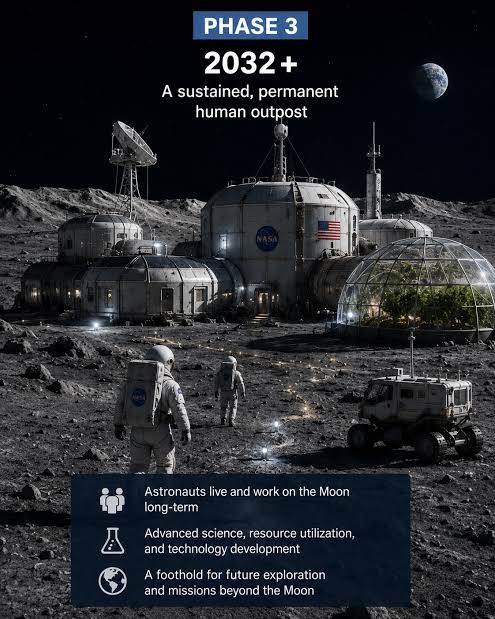
NASA has revealed the next phase of its strategy to establish a long-term human presence on the Moon, detailing plans for robotic landers, hopping drones and transport vehicles that will support future lunar missions.
The initiative is part of the United States’ broader goal of returning astronauts to the Moon before the end of President Donald Trump’s term in 2029, amid growing competition with China in the new space race.
China is also advancing its lunar ambitions and aims to land astronauts on the Moon by 2030. Earlier this week, the country launched the Shenzhou-23 mission carrying astronauts to the Tiangong space station.
In March, NASA announced a $20 billion project to develop a permanent lunar base near the Moon’s south pole by 2032. The facility is expected to rely on both solar and nuclear energy for operations.
NASA Administrator Jared Isaacman said the latest developments demonstrate that the United States would “never give up the Moon again.”
The proposed lunar base is expected to support scientific research, resource extraction and future missions to Mars.
However, experts have questioned whether NASA can meet its ambitious timeline. Although the agency’s Artemis II mission successfully sent four astronauts around the Moon in April, some scientists believe China could still become the next nation to land humans on the lunar surface.
Lunar scientist Simeon Barber noted that NASA still faces major challenges in developing a reliable spacecraft capable of safely landing astronauts on the Moon.
NASA’s Ignition Moon Base programme will unfold in three phases. The first stage will focus on deploying robotic landers and hopping drones to explore and map the Moon’s rugged terrain before astronauts arrive.
The agency also plans to introduce transport vehicles capable of moving astronauts, scientific instruments and communication systems across the lunar surface.
NASA selected companies including Blue Origin, Intuitive Machines and Astrobotic to develop key technologies for the project.
Blue Origin’s Endurance lander is expected to carry out precision landings using autonomous navigation systems, while Astrobotic’s Griffin-1 lander is planned for deployment near Nobile Crater at the Moon’s south pole.
The robotic systems will also transport scientific equipment, including high-resolution cameras and laser-based navigation tools designed to assist with future lunar landings.
According to Moon Base programme executive Carlos García-Galán, the robotic exploration phase is scheduled to continue through 2029, involving 25 launches and the delivery of about four metric tonnes of cargo to the Moon.
The second phase will focus on building solar- and nuclear-powered infrastructure, including fission reactors. By 2032, NASA hopes astronauts will be living in semi-permanent housing on the Moon.
Rovers are also expected to help astronauts travel across the Moon’s harsh and rocky surface.
Scientists view the Moon’s south pole as a key target because of the frozen water believed to exist there, which could provide drinking water and help generate oxygen for future missions.
NASA’s plans still depend heavily on the success of SpaceX’s Starship Human Landing System, which is currently under development but has experienced delays and technical setbacks.
Barber added that safely landing astronauts on the Moon remains the programme’s biggest obstacle, while also pointing to strong political pressure surrounding NASA’s timelines and announcements.
 A story of courage, wonder, and the transformative power of self-belief; perfect for readers aged 10+ who love adventure. To place order: +234 806 130 3237 | +234 803 582 0870 OR Tap the link to grab a copy:https://www.zeekapublish.com/product/the-magical-life-of-anna