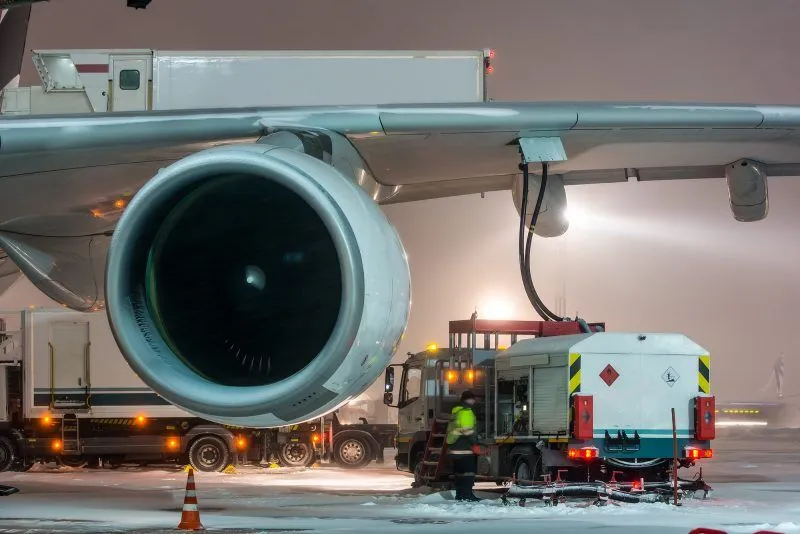
Lagos — Nigeria’s aviation fuel market has undergone a significant turnaround with the Dangote Refinery now serving as the country’s primary source of Jet A1, effectively resolving chronic supply shortages that once crippled airline operations, according to industry executive Toyin Leo-Olagbaiye.
Leo-Olagbaiye, General Manager of Aviation at Ardova Plc, said the refinery’s production has been the most transformative development in the sector in recent years. “It is now the main source of Jet A1 in the country, and its impact has been transformative, particularly in resolving the scarcity problem that once plagued the market,” he noted in an interview.
Prior to the refinery coming on stream, the industry faced dual challenges of both rising prices and persistent fuel shortages. While availability has markedly improved, pricing remains tightly linked to international benchmarks, exposing the market to global crude oil fluctuations, foreign exchange movements, and geopolitical tensions.
Lagos continues to dominate the national aviation fuel landscape, accounting for 60 to 70 percent of all Jet A1 supplied directly into aircraft across Nigeria. Fuel uplift volumes vary dramatically depending on aircraft type and route. A Boeing 747 freighter on a long-haul flight to Rio de Janeiro, for instance, can take up to 130,000 litres in a single refuelling, while a smaller Phenom 300E flying to Abuja may require as little as 1,000 litres.
Despite the improved supply security, Leo-Olagbaiye highlighted ongoing price pressures. “We are in a world where prices have more than doubled (2.5X–3X) from $600–$700 per MT before the US-Iran war to over $1,800 per MT on some days,” he said. Nigerian prices closely track Northwest Europe (NWE) Platts benchmarks, providing airlines with a reliable indicator for forward planning.
He acknowledged that greater stability in Nigeria’s foreign exchange market has reduced some of the uncertainties that previously plagued importers. However, logistics costs particularly road tanker transportation to airports continue to add a structural premium to local prices, unlike markets with pipeline infrastructure.
Geopolitical tensions in the Middle East have driven global supply concerns, but Leo-Olagbaiye credited the Dangote Refinery with providing a vital domestic buffer. “Availability and distribution have not been as severely affected as they would have been in the pre-Dangote era,” he explained.
Increased competition among multiple jet fuel marketers has also helped keep the market efficient and transparent, working to the advantage of airlines and passengers. Ardova Plc, he said, has invested in full value chain integration from vessels and storage to direct into-plane delivery to optimise costs and service quality.
On safety and standards, Leo-Olagbaiye emphasised strict adherence to global best practices. Ardova’s operations comply with the UK Ministry of Defence Standard (DEF-STAN 91-091), Joint Inspection Group (JIG) requirements, IATA guidelines, and local regulations from the NMDPRA and NCAA.
Looking ahead, Leo-Olagbaiye expressed optimism about supply security anchored by domestic refining, but cautioned that pricing will remain subject to global demand and supply dynamics. “We are always going to be at the mercy of global events in terms of pricing,” he concluded.
 A story of courage, wonder, and the transformative power of self-belief; perfect for readers aged 10+ who love adventure. To place order: +234 806 130 3237 | +234 803 582 0870 OR Tap the link to grab a copy:https://www.zeekapublish.com/product/the-magical-life-of-anna