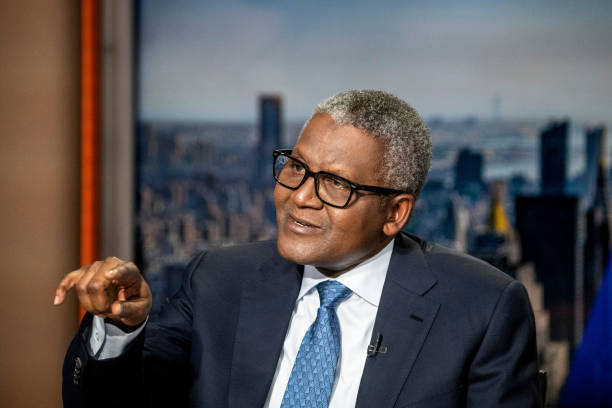
Aliko Dangote, President of the Dangote Group, on Thursday warned that Nigeria risks remaining trapped in poverty unless it abandons its heavy reliance on trading and imports in favour of manufacturing and domestic production.
Speaking at the 25th Annual Conference of Women in Management, Business and Public Service (WIMBIZ) in Lagos, Dangote said no country had achieved lasting prosperity by selling what others produce. He argued that the continued celebration of trading at the expense of industrial production was undermining job creation, wealth generation and economic self-reliance.
Policy inconsistency and inadequate electricity supply, he added, had made manufacturing increasingly difficult for local entrepreneurs.
In a keynote address titled “The Geography of Opportunity: Why the World Needs What Africa Has,” Dangote challenged Nigerian businesses, particularly women entrepreneurs, to move beyond conventional trading into production, processing and other value-adding activities. He said Africa’s natural and demographic advantages would remain largely untapped without deliberate investment in industrial capacity.
Dangote recalled his own shift from trading to manufacturing, driven by the realisation that unreliable policies and poor power supply had made industrial ventures hard to sustain. A management retreat, he said, pushed the group to abandon dependence on import licences and embrace backward integration by producing locally what it had previously imported. That decision laid the foundation for its expansion into cement manufacturing and other industrial activities.
He cited Dangote Cement’s robotic manufacturing plant, which achieved production costs below $2.40—lower than those of Reliance Industries in India—as evidence of the benefits of industrial investment.
On the Dangote Refinery, he said the project was initially dismissed by many international players as unrealistic. Some global contractors declined to take it on, and financial institutions were reluctant to support what they saw as an excessively ambitious investment. The group responded by acting as its own engineering, procurement and construction contractor. The refinery’s design capacity rose from an initial 300,000 barrels per day to 650,000 and eventually 700,000 barrels per day.
During the COVID-19 pandemic, Dangote said the group continued servicing $720 million in loan obligations every six months without securing repayment extensions, even as interest rates rose as high as 40 per cent. He described the experience as a lesson in understanding investments, taking calculated risks and remaining committed to long-term goals despite opposition and uncertainty.
Looking ahead, Dangote noted that one in every four people globally would be African by 2050, yet the continent currently accounts for less than three cents of every dollar of global output. He attributed the gap to inadequate planning, capital flight and the failure to convert natural resource advantages into productive industrial capacity.
Africa possesses about 60 per cent of the world’s arable land and more than 37 per cent of critical minerals, he said, but continues to underutilise them. Nigeria cultivates less than 10 per cent of its arable land despite growing global demand for food and agricultural products. Agriculture, food processing, manufacturing and port infrastructure, he added, would become increasingly strategic as Europe and other regions look beyond their borders for food supplies.
Dangote urged women entrepreneurs to retain capital within Africa and exercise greater care in choosing investment opportunities, warning against committing funds to businesses they did not fully understand. He advised them not to allow consultants and professional managers to dictate their ambitions, insisting that entrepreneurs must understand their investments and maintain control over their long-term vision.
He pointed to the group’s recent public offer, valued at $2.5 billion, which attracted $3 billion in demand from all 54 African countries and investors from about 200 countries. The response, he said, showed that Africans and international investors were willing to commit capital to businesses on the continent when trust and confidence existed. The challenge was to replicate that confidence across the wider African economy by mobilising domestic capital for productive investments.
Africa’s economic transformation, Dangote maintained, would depend less on the opportunities available to it than on its willingness to develop the capacity to exploit them. He urged women and other business leaders to embrace ambitious ventures, take calculated risks and invest in sectors capable of generating jobs and building enduring wealth.
Industrialisation, he stressed, required persistence and long-term commitment; countries could not achieve sustainable development by remaining dependent on trading and importing goods produced elsewhere.
Lagos State Deputy Governor and All Progressives Congress governorship candidate Dr. Kadri Obafemi Hamzat, who also spoke at the conference, said the exclusion of women from affordable financing was limiting the productive capacity of the economy.
Citing World Bank data, he said women own about 40 per cent of Nigeria’s micro, small and medium enterprises but face significantly greater financing constraints than men. Fifty-two per cent of women-led businesses identified access to finance as a major constraint, compared with 30 per cent of male-led enterprises. Fifty-six per cent of women were rejected for their most recent loan applications, against 17 per cent of men.
Hamzat warned that the disparity went beyond gender considerations and deprived the economy of businesses, jobs, innovation and competitiveness. Lagos, he said, needed to move beyond celebrating women’s resilience to dismantling the structural barriers preventing their businesses from growing.
These included multiple and unclear charges, complicated property registration procedures that limited women’s ability to use land as collateral, and government interventions that failed to track whether women were actually benefiting.
Under his proposed Lagos Promise, he said women-led businesses would account for at least 57 per cent of beneficiaries under every state enterprise programme, with results publicly disclosed and audited. He also pledged to expand access to affordable financing through cooperatives, offering loans of up to N10 million at nine per cent interest annually without collateral.
Other proposed measures include simplifying regulatory compliance, reducing harassment of traders who meet their lawful obligations, and connecting women-owned businesses to industrial parks and opportunities under the African Continental Free Trade Area. The objective, he said, was to help women-owned enterprises graduate from small-scale trading into production, processing and export-oriented businesses.
Hamzat cited the Lagos Export Readiness Programme, in which 189 of the 253 participating SMEs were women-owned and 16 of the 20 selected trade champions were women. He also pointed to skills development and micro-enterprise initiatives that had reached tens of thousands of women, stressing the need for improved data to ensure that economic policies and public spending reflected women’s actual contribution to the economy.
 A story of courage, wonder, and the transformative power of self-belief; perfect for readers aged 10+ who love adventure. To place order: +234 806 130 3237 | +234 803 582 0870 OR Tap the link to grab a copy:https://www.zeekapublish.com/product/the-magical-life-of-anna