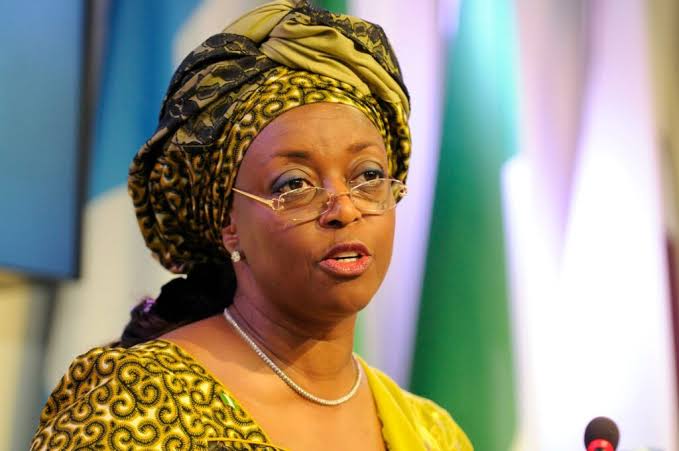
The Economic and Financial Crimes Commission (EFCC) has asked the Federal High Court in Abuja to reject former Minister of Petroleum Resources Diezani Alison-Madueke’s attempt to place her London acquittal before the court in a suit over forfeited assets.
Justice Inyang Ekwo was due on Tuesday, 6 October 2026, to hear the commission’s preliminary objection together with the former minister’s originating motion in suit FHC/ABJ/CS/21/2023. The sitting did not reach those applications. Counsel for Alison-Madueke, Queen-Ubokutom Uwe, told the court that the EFCC had served a further process shortly before the hearing. Justice Ekwo fixed 11 November for the pending motions.
The process in issue is a further counter-affidavit dated and filed on 5 October. It was deposed to by Oyakhilome Ekienabor, a litigation officer in the firm of Mofesomo Oyetibo, SAN, counsel to the commission. In it, the EFCC asks the court to discountenance Alison-Madueke’s further and supplementary affidavit, which seeks to introduce evidence of her discharge and acquittal by Southwark Crown Court.
The commission’s case is that the London proceedings are not being prosecuted in any Nigerian court and have nothing to do with the questions before Justice Ekwo. Ekienabor described parts of the former minister’s depositions as misleading, immaterial and irrelevant. He also argued that parties cannot widen the scope of a suit by introducing facts that divert attention from the issues already joined.
On the assets themselves, the EFCC says the public sale notice does not show that any of the listed properties belong to Alison-Madueke. It further contends that the forfeiture order in view “relates exclusively to items of jewellery and does not extend to any other category of assets or properties.” Those claims are the commission’s, and they have not yet been ruled on.
Paul Mgbeoma, who appeared for the EFCC on Tuesday, told the court he was ready to proceed. He also expressed surprise that the applicant continued to file processes, comparing the volume of filings to an election petition. Uwe, for her part, reminded the court of a motion to regularise her client’s processes.
The objection marks a change in the commission’s courtroom stance. On 1 July, Justice Ekwo granted Alison-Madueke leave to file a supplementary affidavit on the London outcome after her lawyer, Godwin Iyinbor, moved the application. Oyetibo did not oppose it. He told the court that the applicant only wanted to draw attention to her exoneration in the United Kingdom, and he described the motion as capable of wasting judicial time, but he said the EFCC would not contest it. The judge then adjourned to 6 October and directed that the preliminary objection and the substantive suit be taken together.
The United Kingdom decision is not in dispute as a fact. On 17 June 2026, a jury at Southwark Crown Court found Alison-Madueke not guilty of five counts of accepting bribes and one count of conspiracy to commit bribery. Reuters reported that the verdict followed a trial that began in January and more than 46 hours of deliberation. The Organised Crime and Corruption Reporting Project said the case grew out of a long National Crime Agency investigation. Her co-defendants, including oil executive Olatimbo Ayinde and her brother Doye Agama, were also cleared.
In a statement issued through a spokesperson after the verdict, Alison-Madueke said her “nightmare is over” and that the case had hung over her and her family for 11 years. She was Nigeria’s petroleum minister from 2010 to 2015 under former President Goodluck Jonathan, and she later chaired OPEC.
Her Nigerian legal team, in a 10-ground argument associated with Professor Mike Ozekhome, SAN, says the London acquittal is a subsequent event that was not available when she filed her amended originating motion on 19 February 2025. Leave to amend had been granted on 17 February 2025. The suit challenges, among other things, an EFCC public notice for the auction or sale of properties and personal effects said to affect her proprietary rights. Ozekhome’s argument is that a central plank of the case is the imposition of serious proprietary consequences without a conviction, without a fair hearing, and without strict compliance with the statutes on forfeiture, management and disposal of property.
The team says it is not asking the Abuja court to sit on appeal over the English judgment, or to treat that judgment as automatically conclusive in Nigeria. It says the affidavit is meant only to place a later material fact before the judge. It also says the EFCC would not be prejudiced if the evidence is received.
The wider asset history is separate from Tuesday’s narrow dispute, and the two sides do not describe it in the same way. Civil forfeiture orders linked to Alison-Madueke have included jewellery recovered from an Abuja residence and various properties. In 2019 a Lagos Federal High Court ordered the final forfeiture of 2,149 pieces of jewellery and a customised gold iPhone, a decision later affirmed by the Court of Appeal. The Africa Report has also reported other forfeiture orders, including houses, and said some assets were auctioned between 2022 and 2023. Whether those other orders fall inside suit FHC/ABJ/CS/21/2023 is part of what the parties are now contesting.
No ruling was made on Tuesday on the relevance of the London verdict, the scope of the forfeiture, or the former minister’s claim to the assets. The next confirmed date is 11 November.
 A story of courage, wonder, and the transformative power of self-belief; perfect for readers aged 10+ who love adventure. To place order: +234 806 130 3237 | +234 803 582 0870 OR Tap the link to grab a copy:https://www.zeekapublish.com/product/the-magical-life-of-anna