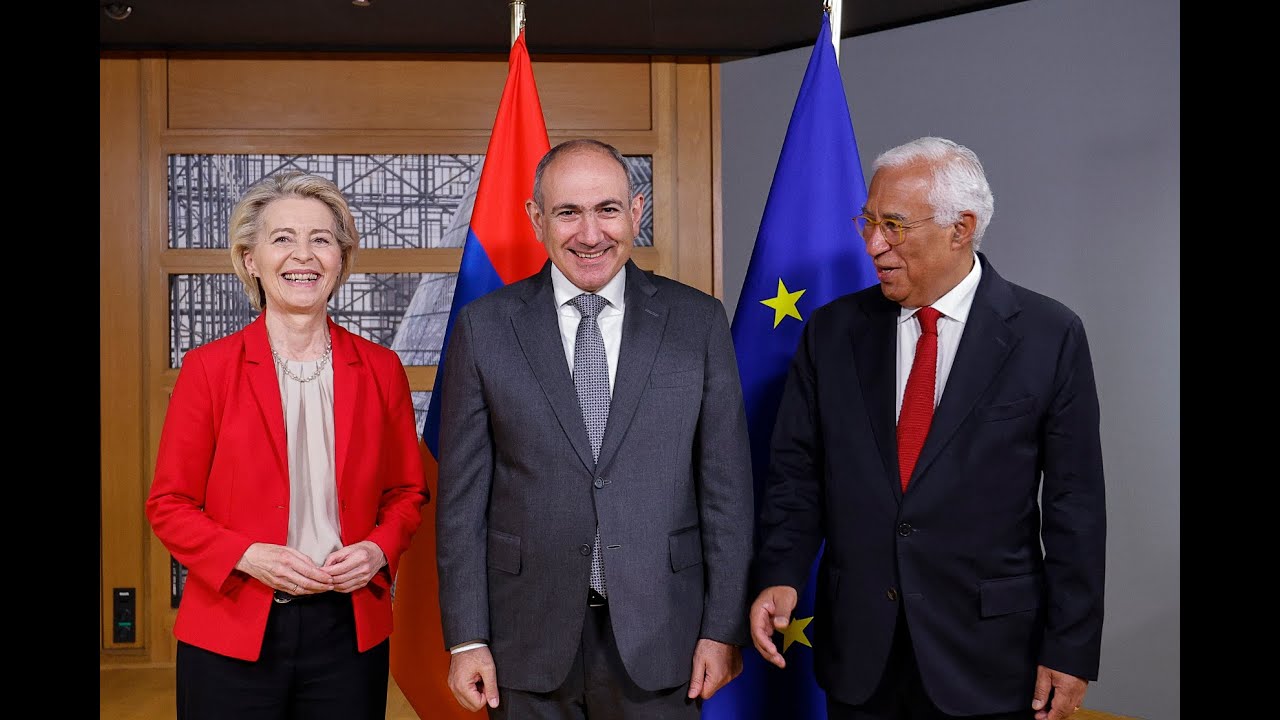
In a striking display of shifting alliances in the Caucasus, Armenia is hosting two unprecedented high-level gatherings on May 4–5, 2026: the 8th European Political Community (EPC) Summit on May 4, immediately followed by the first-ever bilateral EU-Armenia Summit on May 4–5.
These back-to-back events bring dozens of European leaders to Yerevan, underscoring Armenia’s accelerating move away from its traditional reliance on Russia toward deeper integration with Europe.
8th European Political Community (EPC) Summit (May 4, 2026):
This informal pan-European forum gathers leaders from nearly 50 countries (EU members and non-members alike) under the motto “Building the Future: Unity and Stability in Europe.”
It is co-chaired by European Council President António Costa and Armenian Prime Minister Nikol Pashinyan.
Attendees include high-profile figures such as:
EU leaders: Ursula von der Leyen (European Commission President), Roberta Metsola (European Parliament President), and Kaja Kallas.
National leaders: UK PM Keir Starmer, French President Emmanuel Macron, Italian PM Giorgia Meloni, Ukrainian President Volodymyr Zelenskyy, Polish PM Donald Tusk, Canadian PM Mark Carney, and many others (including leaders from the Balkans, Baltics, and beyond).
Discussions center on regional security, democratic resilience, hybrid threats, energy and economic security, connectivity, and broader European challenges (including the war in Ukraine and Middle East developments). The summit also features parallel events like the Yerevan Dialogue and a state visit by Macron.
First-ever EU-Armenia Summit (May 4–5, 2026):
Following the EPC, this bilateral meeting involves Costa and von der Leyen representing the EU, with Pashinyan for Armenia. It aims to deepen ties based on shared values, international law, and the rules-based order.
Launch of an EU-Armenia Connectivity Partnership (covering transport, energy, digital, and people-to-people contacts).
Strengthening of security and defense cooperation, including the establishment of a new EU Partnership Mission in Armenia (EUPM Armenia).
Initialling of a working arrangement with Frontex (European Border and Coast Guard Agency).
A joint declaration and other agreements to boost trade, investment, reforms, and potential progress on visa liberalization and Armenia
Armenia was long considered Russia’s closest ally in the South Caucasus — a member of the Eurasian Economic Union (EAEU), host to a Russian military base, and historically dependent on Moscow for security, particularly in the Nagorno-Karabakh conflict with Azerbaijan.
Relations soured after Russia’s limited support during Azerbaijan’s 2023 operations in Karabakh, which led to the displacement of ethnic Armenians and widespread disillusionment in Yerevan.
Public opinion has shifted sharply toward the West. Under Pashinyan, Armenia has adopted a “diversification” or “multi-vector” foreign policy, but the Western tilt has become dominant:
Pursuit of closer EU ties (building on the Comprehensive and Enhanced Partnership Agreement).
Formal EU candidacy application and domestic reforms aimed at aligning with European standards.
The summits symbolize this pivot. Hosting dozens of European leaders (plus Canada) in Yerevan sends a powerful signal of pan-European solidarity with Armenia’s sovereignty, peace efforts, and reform agenda. Armenia even invited leaders from Azerbaijan and Turkey, reflecting openness to regional dialogue following a recent peace treaty.
These events occur amid Europe’s interest in expanding influence in the South Caucasus for energy diversification, connectivity routes, and countering external (especially Russian) dominance.
Armenia’s goals: attracting EU investment, enhancing security resilience, improving infrastructure, and gaining economic opportunities.
Challenges: Armenia’s economy remains linked to Russia and the EAEU; geography and regional tensions (with Azerbaijan and Turkey) limit rapid decoupling.
The consecutive summits represent a historic milestone — an “unambiguous political signal” of Europe’s commitment to Armenia’s future. They highlight how smaller states can leverage great-power competition to increase their agency.
As the meetings unfold today and tomorrow, concrete deliverables on connectivity, security cooperation, and economic ties will determine how far this reorientation advances.
This is a pivotal moment in post-Soviet geopolitics, driven by Russia’s declining reliability and Europe’s strategic outreach in a volatile but important region.
 A story of courage, wonder, and the transformative power of self-belief; perfect for readers aged 10+ who love adventure. To place order: +234 806 130 3237 | +234 803 582 0870 OR Tap the link to grab a copy:https://www.zeekapublish.com/product/the-magical-life-of-anna