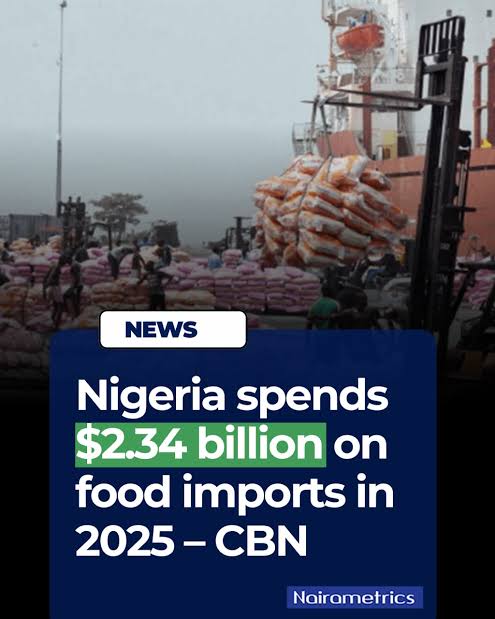
Nigeria spent about $2.34 billion on food imports in 2025, according to the latest figures released by the Central Bank of Nigeria (CBN).
Data contained in the apex bank’s Quarterly Statistical Bulletin showed that food import spending declined by 7.37 percent compared to the $2.53 billion recorded in 2024. The reduction suggests a slight decrease in demand for imported food products, amid ongoing efforts to strengthen local agricultural production and enhance food security.
Despite the decline, food imports continued to place significant pressure on the country’s foreign exchange reserves, with importers utilising an average of $195.28 million monthly throughout the year.
The breakdown showed that foreign exchange used for food imports stood at $213.11 million in January, $195.68 million in February, $141.30 million in March, and $141.13 million in April. The figure increased to $202.83 million in May before dropping to $171.08 million in June.
Demand for foreign exchange strengthened during the second half of the year. Food importers accessed $229.70 million in July, while the figure fell to $175.55 million in August before reaching a yearly peak of $248.60 million in September.
The trend remained elevated in the final quarter, with importers utilising $193.05 million in October, $185.45 million in November, and $245.86 million in December.
The figures highlight the continued reliance on imported food products despite foreign exchange reforms and government initiatives aimed at boosting domestic food production and reducing import dependence.
 A story of courage, wonder, and the transformative power of self-belief; perfect for readers aged 10+ who love adventure. To place order: +234 806 130 3237 | +234 803 582 0870 OR Tap the link to grab a copy:https://www.zeekapublish.com/product/the-magical-life-of-anna