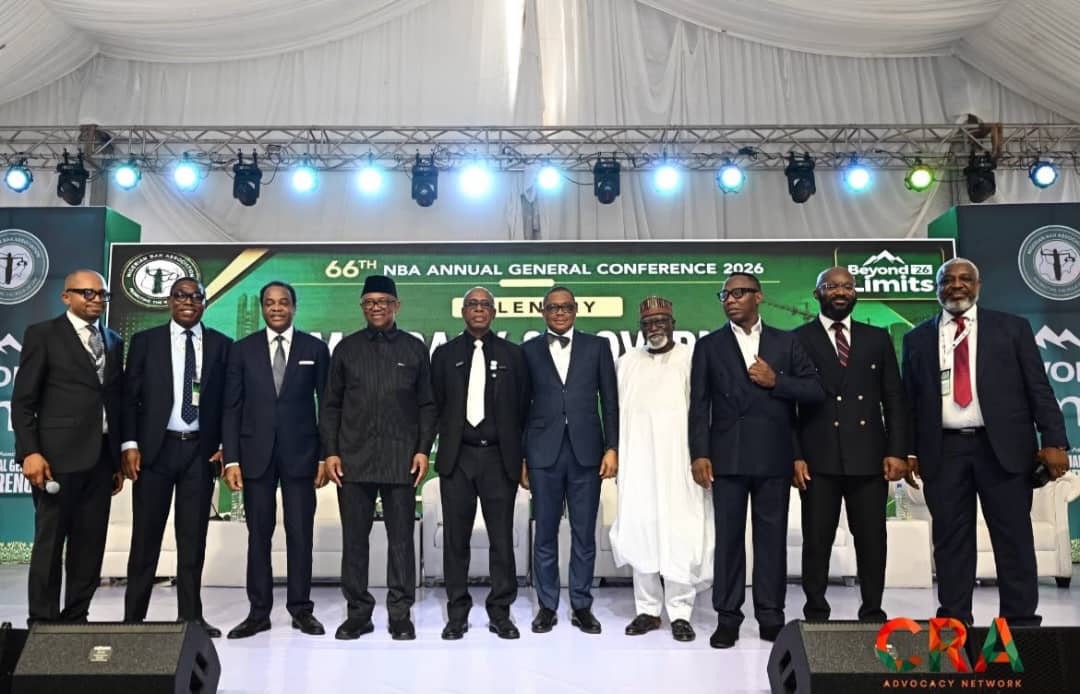
Presidential contenders Peter Obi, Rotimi Amaechi and Omoyele Sowore on Monday traded sharp words over Nigeria’s security challenges, fuel subsidy, governance failures and the nation’s political future at the 2026 Nigerian Bar Association Annual General Conference.
The high-profile panel, a major highlight of the second day of the gathering, saw the three politicians offer competing diagnoses of the country’s worsening insecurity, poverty and leadership crisis ahead of the 2027 general elections.
The exchange grew particularly heated when Sowore took aim at Amaechi’s record as former Rivers State governor. The African Action Congress presidential candidate accused successive governments of subsidising the lifestyles of the political elite rather than protecting ordinary Nigerians.
“The question about subsidy is, who are you subsidising? You are subsidising the elite. You are subsidising the governors. The only people who are doing well since they removed subsidy were the governors of states,” Sowore said.
He insisted that fuel subsidy had been removed several times in the past without delivering the promised benefits. “I was a student in 1989, they removed subsidy. In 1990, they removed subsidy. They said Nigeria will be better. We are in 2026, they are still removing subsidy.”
Turning to Amaechi, Sowore criticised the former transport minister’s rail project in Rivers State, arguing that a functional rail system would have made subsidy more beneficial to the people. “If that rail line was working, subsidy would have been working for the people of Rivers State.”
Sowore maintained that he would not remove the fuel subsidy if elected, insisting that government support must prioritise the poor. He also pledged to ensure that those who looted public resources face justice.
Amaechi hit back, rejecting Sowore’s characterisation of his record and defending both his political experience and the opposition coalition that includes former Vice-President Atiku Abubakar. He accused the political establishment of enabling corruption and electoral manipulation, while insisting the coalition remained determined to defeat the ruling All Progressives Congress.
The former Rivers governor also defended his tenure as transport minister, saying he ensured fair representation from different parts of the country in appointments under his ministry.
Labour Party’s Peter Obi offered a different diagnosis, linking insecurity directly to poverty and Nigeria’s failure to build a productive economy. The former Anambra governor argued that the country is not inherently poor but has been impoverished by corruption, weak leadership and underinvestment in agriculture and other productive sectors.
“Nigeria is poor because those of us who are leaders are stealing the wealth of Nigeria and driving Nigeria into poverty,” Obi said. He noted that Nigeria had slipped further on the global hunger index in recent years and that even war-torn Ukraine had supplied grain to the country.
“If we decide today to invest in critical areas of development, which include pulling people out of poverty by investing in agriculture, we can make more money from agriculture than we make from oil,” he stressed.
Obi also criticised the political class for exploiting ethnic and religious divisions, arguing that ordinary Nigerians do not share the same deep-seated divisions that politicians promote. He further lamented the erosion of electoral standards, saying the National Assembly’s stance that forgery is not an offence in electoral matters had created a situation where “all is fair in politics.”
On the contentious issue of state police, the candidates largely expressed support. The Social Democratic Party candidate advocated a three-tier structure involving federal, state and local government policing.
Earlier, Chief of Staff to the President, Femi Gbajabiamila, in a keynote address titled “Policing in Transition,” defended the federal government’s plan to establish state police. He said the reform was necessary to address longstanding weaknesses in Nigeria’s centralised policing system, but warned that it must be accompanied by strong safeguards.
Gbajabiamila noted that Nigeria currently has about one police officer for every 650 citizens, against an international benchmark of roughly one to 450. This, he said, leaves the country short by approximately 160,000 officers, with the practical deficit even larger because many personnel are tied down by administrative and protection duties.
He stressed that increasing numbers without raising standards would create greater danger, insisting that entry into the police force must remain rigorous, with proper background checks, training and institutional protection for officers who refuse unlawful orders.
Former Cross River State governor Donald Duke also spoke, emphasising that getting leadership right remains fundamental to solving Nigeria’s broader problems. He urged Nigerians to rise above ethnic considerations that continue to dominate presidential politics.
The exchanges at the NBA conference underscored the sharp differences among key opposition figures as the country inches toward the 2027 elections, with insecurity, economic hardship and questions of political accountability dominating the national conversation.
 A story of courage, wonder, and the transformative power of self-belief; perfect for readers aged 10+ who love adventure. To place order: +234 806 130 3237 | +234 803 582 0870 OR Tap the link to grab a copy:https://www.zeekapublish.com/product/the-magical-life-of-anna