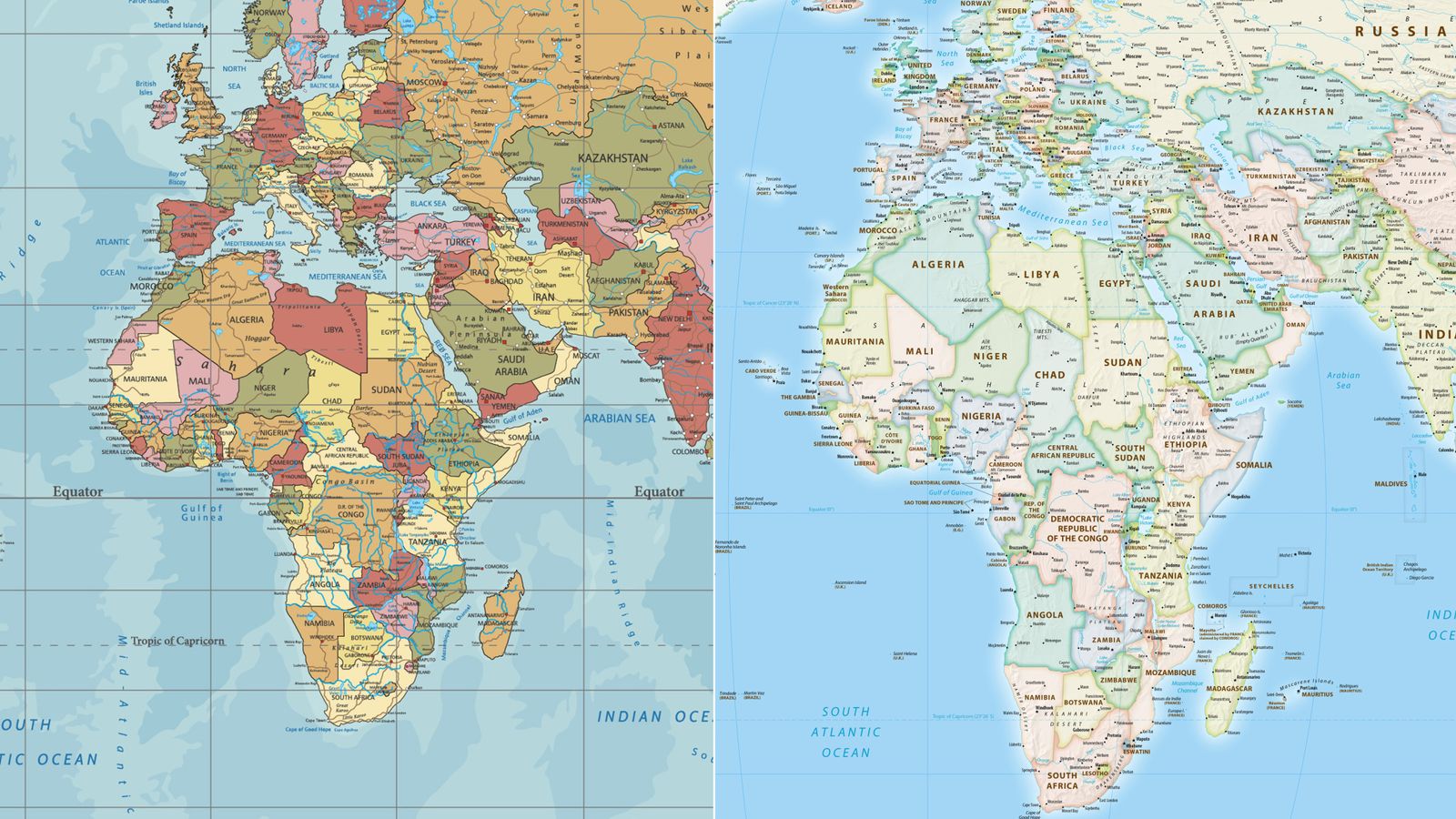
The UN General Assembly has approved a resolution urging governments, schools, international bodies and technology companies to move away from the traditional Mercator world map toward projections that more accurately show the relative size of continents, especially Africa.
The non-binding “Correct the Map” text, introduced by Togo and supported by African Union members, passed on Friday with 164 votes in favour, including France and the United Kingdom. The United States was the only country to vote against it. Six states abstained.
The resolution does not ban the Mercator projection, which remains useful for navigation. Sponsors say it is intended to change how the world is drawn in classrooms, official materials and everyday digital maps.
Supporters argue that Mercator maps have long made Africa look far smaller than it is. On that projection, Greenland can appear roughly the same size as the African continent, even though Africa is about 14 times larger. Critics say that visual imbalance has shaped how people judge the scale, resources and importance of countries near the equator.
Togolese Foreign Minister Robert Dussey told Reuters ahead of the vote: “A fair world begins with a fair map.” At a UN briefing he added: “A map is never neutral. It shapes perceptions, influences how the place of peoples and continents in the world is understood.”
French Foreign Minister Jean-Noël Barrot said France would stop using the Mercator map. “Changing the map obviously doesn’t change the world. But correcting a representation that distorts it is already an act of truth,” he said.
US representative Yaryna Ferencevych criticised the resolution as a poor use of the Assembly’s time. “Instead of focusing on genuine problems of international peace, prosperity, or good relations, this body is debating map projects from the 16th Century, and their role in promoting reparations and ‘cognitive justice’,” she said. Washington had also objected earlier this year to a separate resolution describing the transatlantic slave trade as “the gravest crime against humanity.”
Flemish cartographer Gerardus Mercator created the projection in 1569 to help European sailors plot courses. Flattening a sphere onto a rectangle stretches landmasses toward the poles and compresses those near the equator. The result is a map that is practical for navigation but misleading as a picture of relative area.
In 2018, cartographers introduced the Equal Earth projection, designed to keep continental areas closer to their true proportions. In February, the African Union’s 54 member states endorsed that approach, saying it “more accurately represents the sizes of all continents, particularly Africa.”
Campaigners behind #CorrectTheMap have argued that Africa could contain the United States, China, India, Japan, Mexico and much of Europe and still have room left over.
Lerato Mogoatlhe of Africa No Filter, one of the groups pressing the issue, told the BBC: “Africa’s misrepresentation on world maps is not just a cartographic error – it’s a narrative issue.” She described the effort as a response to what she called the “world’s longest misinformation and disinformation” about the continent.
Kenyan geographer Kioko Muendo said the older projection had implicitly understated Africa’s resources, population and investment potential. “Maps are more than just guides for travellers – they shape how regions are perceived politically and economically,” he told the BBC.
Because the resolution is not legally binding, countries and companies are not required to abandon Mercator maps. The political signal is expected, however, to influence textbooks, official publications and online mapping tools. Togo has said it wants Equal Earth maps in its schools by the end of the year, and France has already said it will change its official practice.
 A story of courage, wonder, and the transformative power of self-belief; perfect for readers aged 10+ who love adventure. To place order: +234 806 130 3237 | +234 803 582 0870 OR Tap the link to grab a copy:https://www.zeekapublish.com/product/the-magical-life-of-anna