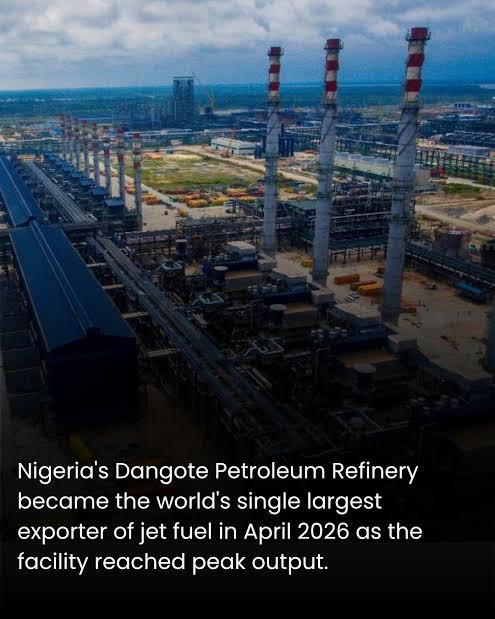
Dangote Petroleum Refinery has reportedly become the world’s largest exporter of jet fuel in April, following a sharp rise in production and disruptions in global fuel supply caused by tensions in the Middle East, according to a report by S&P Global Energy.
The report, which featured comments from the refinery’s Chief Executive Officer, David Bird, stated that changing global fuel trade patterns created increased demand for alternative aviation fuel suppliers, placing the Nigerian refinery in a strong position within the international market.
Data from S&P Global Commodities at Sea revealed that the refinery emerged as the leading exporter of aviation fuel after the conflict in the Middle East disrupted major supply routes. According to the report, Dangote Refinery switched to what Bird described as “max jet mode” shortly after the conflict began, significantly increasing jet fuel production.
The refinery, currently operating at an estimated capacity of 650,000 barrels per day, has maintained near-maximum output levels to meet growing export demand. It has also adopted flexible blending techniques by importing feedstocks such as gas-to-liquids naphtha and Bonny condensate to improve gasoline production beyond its standard configuration.
Bird explained that maintaining such large-scale operations requires more advanced trading systems, stronger logistics coordination, and dependable supply chains as the refinery expands its reach in global markets.
The report added that Dangote Refinery is gradually evolving into a merchant refinery model, actively trading crude oil and refined petroleum products internationally instead of functioning solely as a domestic processor.
The facility is also broadening its crude intake beyond Nigerian light sweet crude to include heavier crude grades and residue blends. It currently has the ability to process around 40 crude varieties, with plans to increase that number over time.
According to Bird, the refinery aims to eventually reach a production capacity of 1.4 million barrels per day, a target that would require sourcing additional crude supplies from countries in the United States, the Middle East, and South America.
He further disclosed that the company is pursuing long-term supply agreements with governments, airlines, and national oil firms to reduce reliance on spot market transactions.
Bird noted that the refinery’s long-term goal is to become comparable to major global refining hubs such as Singapore’s Pulau Bukom refinery, known for processing over 100 crude grades.
In addition to refining operations, the company is investing in regional infrastructure projects, including proposed storage and logistics facilities in Namibia, pipeline initiatives in Zambia, and storage developments across Central and East Africa.
He added that the broader objective is to transform the Lekki Free Zone into a major industrial and energy hub centered on refining, petrochemicals, and export logistics.
The increase in jet fuel exports came during a period of heightened global market uncertainty caused by the conflict involving the United States, Iran, and Israel. Concerns over possible disruptions around the Strait of Hormuz — a key route for nearly 20 percent of global oil and fuel trade — tightened global supply chains and pushed up aviation fuel prices.
The resulting market shift created new opportunities for suppliers outside the Middle East, contributing significantly to Dangote Refinery’s rise as the world’s leading exporter of aviation fuel in April.
The surge in jet fuel prices also affected Nigeria’s aviation sector, prompting the Federal Government to introduce price controls and a 30-day credit arrangement for airlines to reduce operating pressures.
Under measures coordinated by the Nigerian Midstream and Downstream Petroleum Regulatory Authority (NMDPRA), Jet A1 prices were regulated within benchmark ranges of N1,760 to N1,988 per litre in Lagos and N1,809 to N2,037 per litre in Abuja.
Earlier in May, Dangote Refinery reduced its ex-depot aviation fuel price from N1,750 to N1,650 per litre and introduced a 30-day interest-free credit facility for marketers and airline operators.
The company also converted Jet A1 sales from dollar-based pricing to naira transactions in an effort to stabilise domestic supply and ease financial pressure on Nigerian airlines.
 A story of courage, wonder, and the transformative power of self-belief; perfect for readers aged 10+ who love adventure. To place order: +234 806 130 3237 | +234 803 582 0870 OR Tap the link to grab a copy:https://www.zeekapublish.com/product/the-magical-life-of-anna