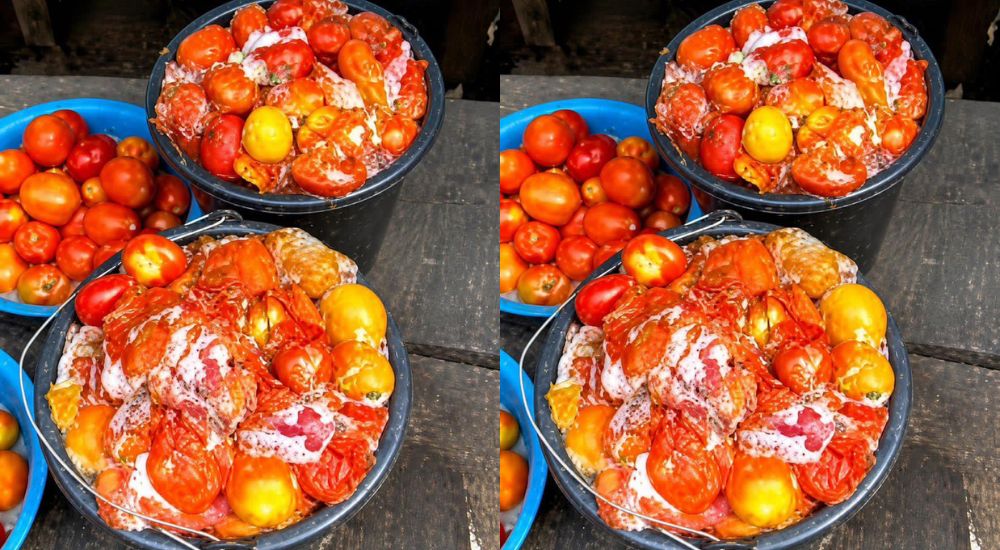
Despite repeated warnings from the Lagos State Government against consuming spoiled tomatoes, worsening economic hardship and soaring food prices have forced many Nigerians to resort to buying rotten tomatoes, popularly known as “baje.”
Authorities had cautioned residents against eating spoiled tomatoes, stressing that fungi-infested produce contains harmful toxins capable of causing severe health complications, including liver damage.
The warning followed recent concerns over tomato infestations in Kano State, one of Nigeria’s major tomato-producing hubs, where pest attacks destroyed several farms and raised fears of nationwide shortages and escalating prices.
Findings by THE WHISTLER revealed that many Nigerians now deliberately seek out broken baskets of spoiled tomatoes because fresh produce has become unaffordable.
A visit to Orange Market in Mararaba, Nasarawa State, showed that tomato prices increased by more than 400 percent within one week, intensifying the burden on traders and consumers already struggling with economic hardship.
According to findings, baskets of tomatoes previously sold for between N20,000 and N25,000 now cost as much as N90,000, depending on the variety. Smaller baskets that once sold for N15,000 are now priced between N45,000 and N60,000.
Traders attributed the sharp increase to seasonal scarcity, rising transportation expenses, higher fuel prices, and recent pest infestations affecting tomato-producing states.
Tomatoes are warm-season crops commonly cultivated between December and March to support harvests during the lean period between May and August, when scarcity often drives prices higher.
Although seasonal price hikes are common during this period, traders noted that this year’s increase happened unusually fast.
A tomato trader identified as Umaru told THE WHISTLER that many retailers now avoid purchasing full baskets because they often incur losses.
According to him, spoiled tomatoes currently attract more buyers than fresh produce because consumers can no longer afford healthier options.
“People no longer buy fresh tomatoes like before. The cost is too high. Even spoiled tomatoes now sell faster because people can afford them more,” he said.
Another trader, Ben Anebi, lamented declining patronage, revealing that consumers now intentionally search for broken baskets instead of fresh tomatoes.
“There is more demand for broken baskets now. A broken basket can sell between N25,000 and N30,000. Before now, we threw them away, but people prefer them now because they are cheaper,” Anebi explained.
He added that many sellers now deliberately keep spoiled tomatoes because demand has risen significantly.
For Isa Ibrahim, rising transportation costs have worsened the crisis, adding that pepper prices have climbed even faster than tomato prices.
“A 50kg bag of pepper that sold for N40,000 before now costs N120,000,” he said.
Isa explained that soaring prices have forced retailers to contribute money collectively to purchase and share bags of tomatoes and pepper, a trend he said has reduced wholesale patronage and affected traders’ profits.
“We know this is usually the season for scarcity, but it has never been this bad. Retailers now contribute money to buy a bag of pepper. Although there is an influx of traders in the market, demand has dropped,” he added.
Another trader who imports tomatoes from Jos blamed rising fuel and transportation costs for the worsening food crisis and called on the Federal Government to reduce fuel prices to ease pressure on traders and consumers.
Meanwhile, reactions among Nigerians remain divided. While some condemned the practice of consuming spoiled tomatoes, others admitted adopting methods they believe make them safer despite repeated medical warnings.
Vera Yakubu, a security personnel in Abuja, described the practice as dangerous.
“I would rather cook palm kernel stew (Banga) or vegetable sauce than buy spoiled tomatoes,” she said.
However, Mrs. Maryann Doko argued that consuming spoiled tomatoes has existed for years.
“Nigerians cannot stop eating it because many people, myself included, believe once it passes through fire, it is safe,” she said.
A mother of three living in Jikwoyi, Abuja, identified as Josephine, told THE WHISTLER that two baskets of “baje” tomatoes are enough to prepare stew for her family.
When asked about the health risks, she said, “I wash the broken tomatoes very well and blend them with potash so the sour taste will reduce.”
Potash, commonly known as kaun or akanwu in Nigeria, is traditionally used in local cooking as a tenderizer or thickener. However, health experts warn that excessive consumption may pose serious health risks.
The New York State Department of Agriculture and Markets has warned that products containing heavy metals such as lead and arsenic may be linked to cancer, skin lesions, cardiovascular disease, neurotoxicity, diabetes, developmental complications, and learning disabilities.
 A story of courage, wonder, and the transformative power of self-belief; perfect for readers aged 10+ who love adventure. To place order: +234 806 130 3237 | +234 803 582 0870 OR Tap the link to grab a copy:https://www.zeekapublish.com/product/the-magical-life-of-anna